
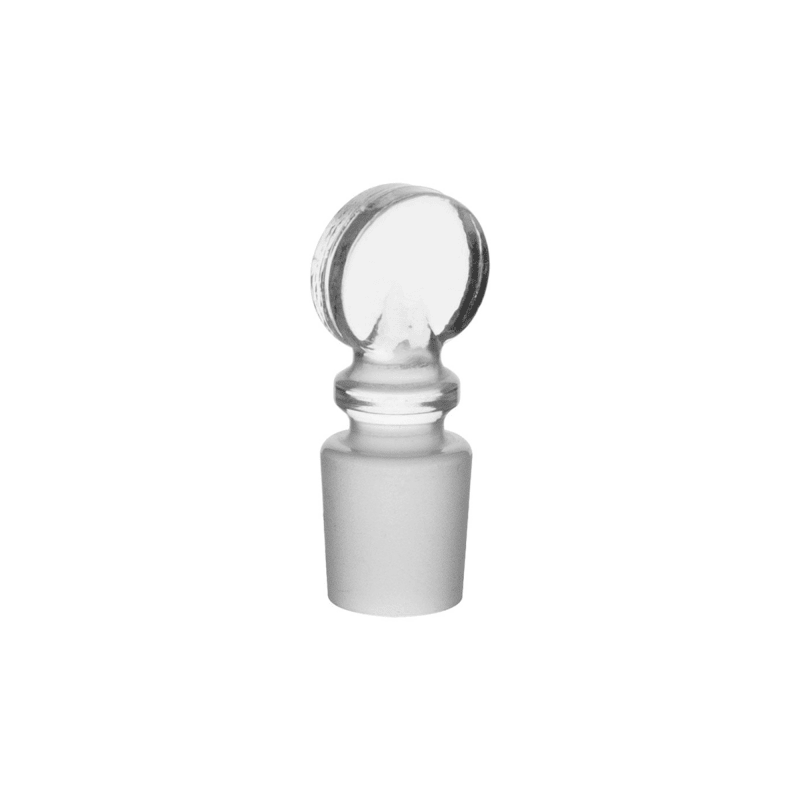
Interchangeable Penny Head Glass Stoppers designed for standard laboratory ground glass joints. These stoppers are primarily used to seal volumetric flasks, mixing cylinders, and separatory funnels.
Technical Specifications
- Material: High-quality 3.3 Borosilicate Glass with high chemical and thermal resistance.
-
Design:
- Standard Taper (1:10): Precision-ground to ensure interchangeability with any standard ground glass socket.
- Drip-Tip: The lower closed end features a pointed tip to ensure adhered liquid returns to the vessel, preventing joint contamination.
- Head Style: Available in Penny Head (flat circular grip) for volumetric flasks.
Available Sizes
These stoppers are categorized by their cone size to match specific capacities of volumetric flasks and reagent bottles:
| Cone Size | Application / Capacity | |
|---|---|---|
| 10/19 | Volumetric Flask (5, 10, 20, 25 mL) | |
| 12/21 | Volumetric Flask (50 mL) | |
| 14/23 | Volumetric Flask (100, 200, 250 mL) | |
| 19/26 | Volumetric Flask (500 mL) | |
| 24/29 | Volumetric Flask (1000mL) | |
| 29/32 | Volumetric Flask (2000mL) | |
Comparison
While Amber Stoppers are required for light-sensitive reagents, these Clear Stoppers are the standard for general laboratory solutions and visual monitoring of sample levels.
Specifications
- Material: Clear 3.3 Borosilicate Glass
- Drip-Tip: No
- Joint Size: Select from drop down
- Head: Penny Head (flat circular grip)
- Brand: OMSONS
- Product of India
Safe Autoclaving Guidelines
To prevent damage to the stopper or the vessel it is paired with, follow these best practices:
- Loosen the Joint: Never autoclave a stopper that is firmly seated or "greased" in a joint. Thermal expansion can cause the glass to crack or the stopper to become permanently "frozen" in place.
- Venting: Ensure there is a path for steam to enter and pressure to equalize. It is often recommended to place a thin strip of paper between the ground glass surfaces or to set the stopper loosely on top of the flask.
- Standard Cycles: They can typically withstand standard autoclave cycles (e.g., 121°C at 15 psi for 15–20 minutes).
- Avoid Rapid Cooling: Do not move hot glassware directly into a cold environment or water, as even borosilicate glass can fail under extreme, sudden temperature differentials.