
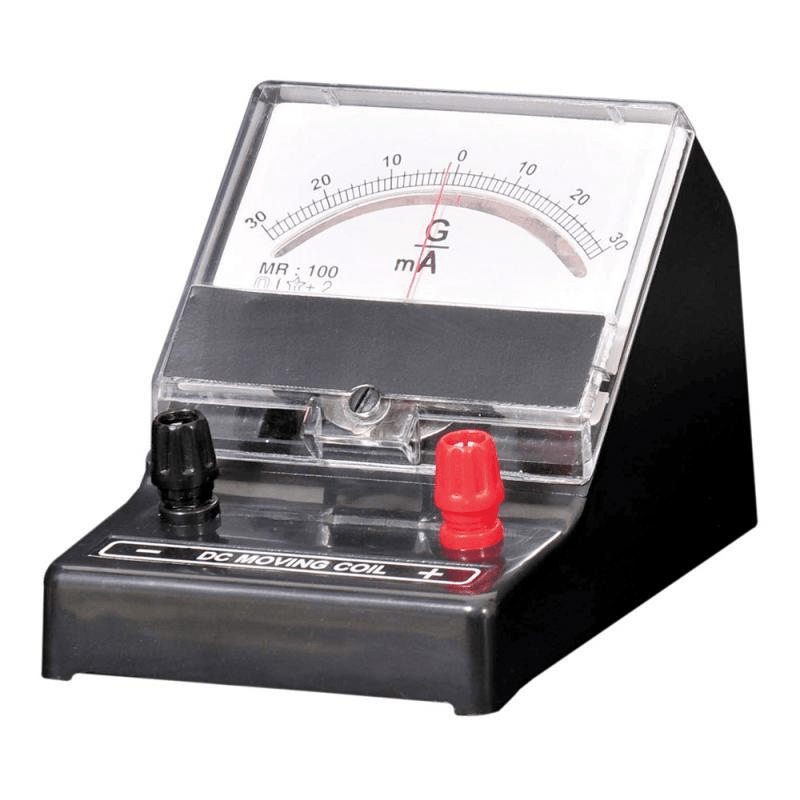
DC type galvanometers are sensitive electromechanical instruments used primarily to detect and measure extremely small electric currents in direct current (DC) circuits. They operate on the D'Arsonval/Weston moving coil principle, where current flowing through a coil in a permanent magnetic field generates a proportional torque that deflects a pointer.
Moving Coil Meters DC Type EDM-80 Square Clear acrylic front cover, fully enclosed economically priced and offer + 2.5% accuracy. Scale length 60 mm Overall size 125 x 80 x 80 mm with zero adjustment and connection terminals.
Applications in the Laboratory
- Null Detection: Their most frequent use is as a null indicator in bridge circuits, such as the Wheatstone Bridge or Kelvin Double Bridge, to identify the point of zero current.
- Potentiometer Experiments: Used to determine the balance point when measuring unknown electromotive forces (EMF).
- Conversion: While designed for small currents, a DC galvanometer can be converted into an ammeter by adding a parallel shunt resistor or into a voltmeter by adding a high series resistor.
Key Specifications
- Sensitivity: Typically measured in microamperes per division (µA/div). Common lab models like the EDM-80 offer sensitivities around 20 µA/div or 1 mV/div.
- Scale Design: Most laboratory galvanometers feature a centre-zero scale (e.g., 30-0-30 or 50-0-50), allowing them to indicate both the magnitude and the direction of current flow.
- Damping: To prevent the needle from oscillating excessively, these devices use eddy current damping (often an aluminium frame for the coil), ensuring the pointer settles quickly to its reading.
- Accuracy: Standard educational and industrial analog models typically offer an accuracy of ±2% to ±2.5% of full scale.