
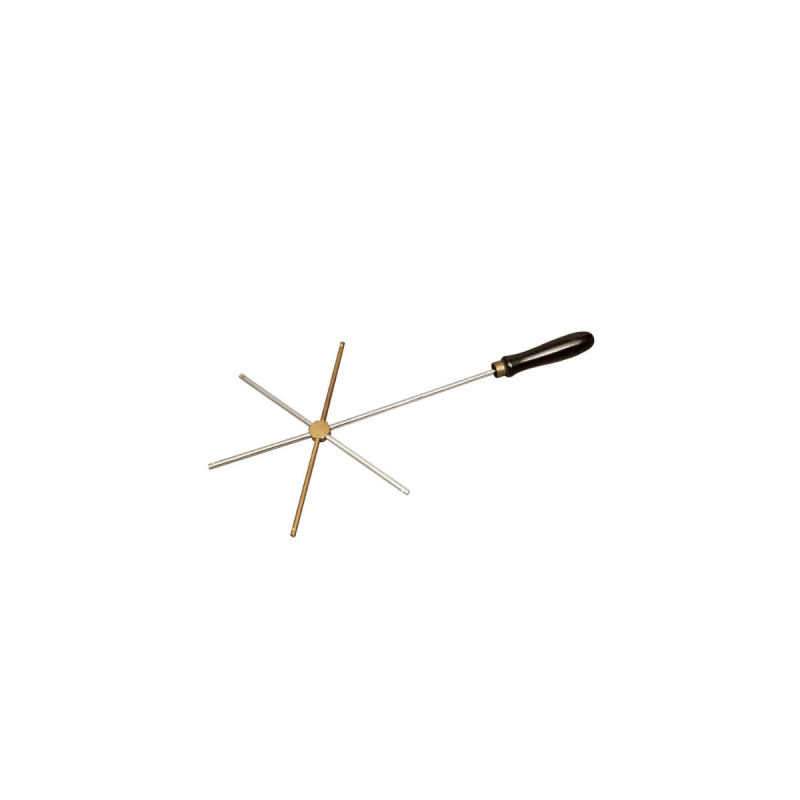
In school laboratories, a conductometer (or conductivity meter) is used in two primary types of experiments: thermal conductivity (Physics) and electrical conductivity (Chemistry).
1. Physics: Thermal Conductivity of Metals
A common physics conductometer consists of five different metal spokes (Aluminum, Brass, Iron, Nickel, and Copper) radiating from a central hub.
- Objective: To compare how quickly heat travels through different metals.
-
Procedure:
- Place a small piece of wax or a match head in the indentation at the end of each spoke.
- Hold the central hub over a Bunsen burner flame.
- Observe the order in which the wax melts or the match heads ignite.
- Typical Result: Copper usually conducts heat the fastest, followed by Aluminum, Brass, and Iron.
2. Chemistry: Electrical Conductivity of Solutions
In chemistry, a conductometer (often a probe connected to a meter or a simple LED circuit) measures a solution's ability to conduct electricity.
- Objective: To identify the presence of ions (electrolytes) in various liquids.
-
Standard Lab Activities:
- Testing Household Liquids: Measuring the conductivity of tap water, distilled water, vinegar, and salt solutions.
- Conductometric Titration: Monitoring the change in conductivity as an acid is added to a base to find the precise neutralization point.
- Concentration Studies: Observing how conductivity increases as more salt is dissolved in water.